

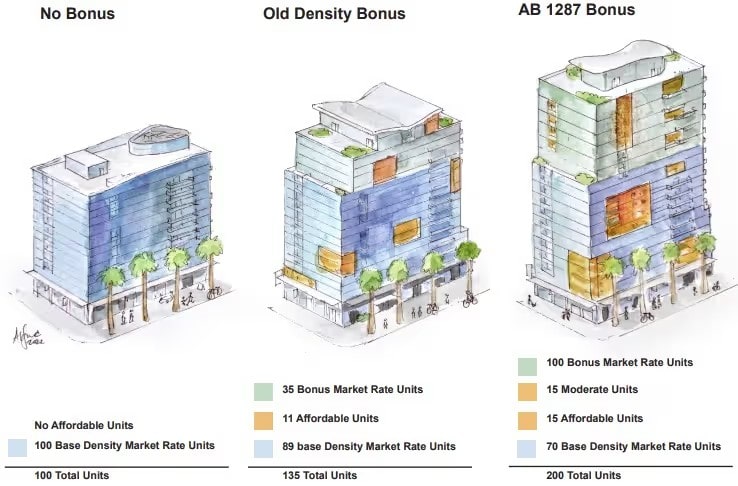
According to a new report, recently released by Circulate San Diego, California’s Density Bonus Law has quietly become one of the state’s most effective tools for producing affordable housing. The report titled, Win‑Win Bonus: How Bonus Law Quietly Transformed California’s Housing Approvals, documents how recent reforms have increased housing production while maintaining project feasibility.
At its core, Density Bonus Law creates a straightforward bargain. When developers include deed‑restricted affordable units in their projects, they receive a meaningful incentive that can help offset the added cost.
These incentives include parking reductions, development standard waivers, entitlement certainty, and streamlined approvals, all tools that directly address the real barriers to building housing in California.
Legislative updates in 2020 and 2023 strengthened this bargain by allowing projects to grow up to 50 percent larger, and in some cases up to twice the size otherwise allowed under local zoning. As a result, Density Bonus Law has become one of the most widely used streamlining laws in the state, accounting for nearly half of all multifamily housing approvals in 2024. Since 2020, it has facilitated approvals for more than 140,000 homes, including over 69,000 deed‑restricted affordable units.
The report highlights that affordability requirements work best when paired with strong, predictable incentives. Rather than discouraging development, Density Bonus Law has aligned economic feasibility with public policy goals, proving that well‑designed incentives can deliver both market‑rate and affordable housing at scale.
As California looks for solutions to its housing crisis, Density Bonus Law offers one clear model for how to produce more affordable homes without slowing development or sacrificing feasibility. We like it!
Source: Colin Parent, Win‑Win Bonus: How Bonus Law Quietly Transformed California’s Housing Approvals, Circulate Planning & Policy