
Last week, we wrapped our Spring Conference and proved our concept that moving the event from Sacramento to Napa was the right call. Our team was so energized by the momentum, insight, and sense of shared purpose that filled every corner of the event. From start to finish, the program delivered. Early on-the-ground feedback indicates that the conference delegation loved the location change, the resort choice, and the opportunity to come together in the beautiful Napa Valley for the benefit of our industry. Our panels were timely, substantive, and deeply engaging, bringing together leaders from across our field to tackle the most pressing issues facing affordable housing today. Whether discussing financing strategies, policy developments, or the evolving challenges in our communities, the quality of the dialogue was a powerful reminder of the expertise and commitment within this community.
What I heard over and over again was commentary around the strength of our sessions and a theme that what continues to set our conferences apart are the moments in between. The conversations in the hallways, the connections made over coffee breaks, and the candid discussions during lunches are where relationships are strengthened and new alliances are formed. These interactions are essential to our collective progress. They create the trust, collaboration, and shared vision that allow us to move the needle in meaningful ways long after the conference concludes.
Following our welcome reception, our PAC was proud to host a successful fundraiser in support of California State Controller Malia Cohen’s re-election campaign.
While some may not see an immediate connection between affordable housing and the State Controller, the office plays a critical behind-the-scenes role in making affordable housing possible by safeguarding the financial systems that support it. As California’s chief fiscal officer, Controller Cohen ensures that public funds, including those used for housing, are properly managed, transparently tracked, and responsibly invested. This oversight helps maintain trust in housing programs, supports the stability of key financing tools like tax credits, and strengthens the overall fiscal foundation that affordable housing depends on. Through this lens, the Controller’s leadership is essential to sustaining and expanding housing opportunities across the state.
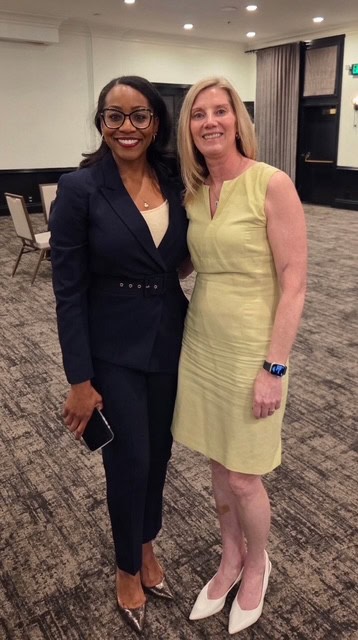
It was a wonderful opportunity to come together in support of leadership that understands the importance of affordable housing and the role it plays in California’s future and we are grateful to everyone who helped make the evening such a success.
While our conferences are vital, our advocacy work continues every day in Sacramento. Even as we were producing the conference, we worked hard with housing champions in the Legislature and other mission aligned organizations to ensure that funding for affordable housing was included in the Governor’s budget. And our efforts paid off! We want to extend our sincere appreciation to the Legislature for restoring the $500 million in additional Low-Income Housing Tax Credit (LIHTC) authority back into Governor Newsom’s budget bill.
At the same time, we are continuing to advance our sponsored legislation. In addition to our two initial sponsored bills, the EV charger mandate delay bill (AB 2748 – Quirk-Silva) and the welfare property tax exemption bill (AB 2089 – Ward) we recently joined author Senator Scott Wiener as a co-sponsor on SB 677, along with California YIMBY and Housing Action Coaliton. This bill addresses growing challenges related to local approvals and TEFRA hearings that have been delaying housing projects across the state. The bill takes a targeted approach to removing unnecessary barriers by limiting the ability for third parties to file frivolous appeals of parcel maps, an issue that has stalled otherwise fully entitled housing developments, and by strengthening protections around the TEFRA process. Specifically, SB 677 clarifies that a local jurisdiction’s failure to provide the required TEFRA approval for tax-exempt private activity bonds constitutes a disapproval of a housing project under the Housing Accountability Act. This is a critical fix, as delays in TEFRA approvals can jeopardize time-sensitive financing, including bond allocations and tax credits, and ultimately put entire developments at risk. By reducing these procedural delays and increasing accountability at the local level, this legislation will help ensure that affordable housing projects can move forward on schedule and with greater certainty. You can see the Fact Sheet here.
Finally, we’re closely reviewing the long-awaited updated Loan Portfolio Restructuring (LPR) guidelines released by HCD regarding AB 130 and SB 686, which govern the extraction of equity. These guidelines, marked as final by the Department, were released partway through day one of our conference. While this is an important development, it is clear that more work remains. The Department ennumerated a list of acceptable uses for the proceeds of early payoff in the guidelines and also included a bullet that allows for other uses as approved by the Department. Uses in this category require a 50% share of earned equity to be paid to HCD. This section raises concerns for us. We will continue to engage with stakeholders and policymakers as we dig deeper into these guidelines and advocate for workable solutions.
In partnership,