

By Jenna Abbott, Executive Director CCAH
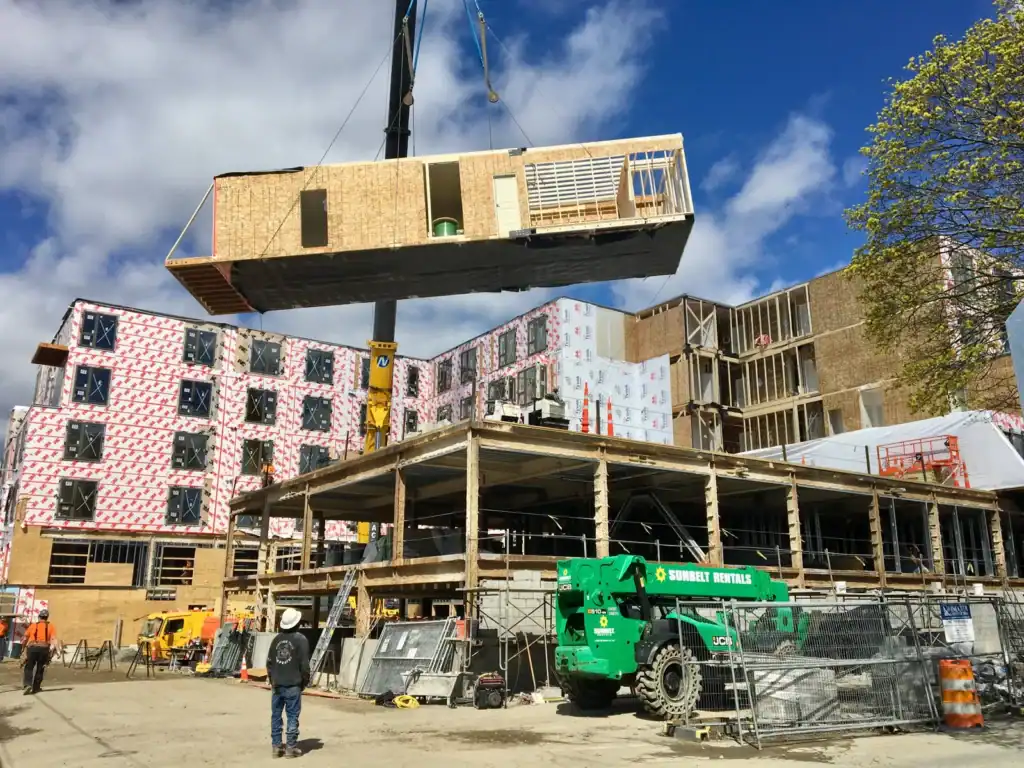
There’s a growing recognition in affordable housing that if we want to build more homes faster, we can’t rely solely on the same construction methods we’ve used for decades. Costs keep rising, timelines keep stretching, and the need keeps outpacing our ability to deliver. That’s why factory‑built or modular multifamily housing is getting so much attention. Not because it’s trendy, but because it’s practical and it works to help us get people housed sooner. Assemblywoman Buffy Wicks saw the benefits, the cost savings and the wisdom of the idea of factory built, and her suite of bills aimed at making modular easier in California is working its way through the legislature as we go to print.
If you haven’t seen modern modular construction up close, this short video is a great introduction: https://app.box.com/s/dpoezdbqo84mvt9zjxczo5jjyg07l5u5
One of the biggest advantages modular brings to affordable housing is speed. Instead of waiting for the site to be fully prepped before you even start building, modular lets you do both at the same time. While the foundation is going in, the units, complete with kitchens, bathrooms, and finishes are being built in a factory. That parallel process can shave months off a schedule. And in affordable housing, months matter. Heck, with a time clock running with a two-year deadline from award to lease up, days matter. And time is money.
But here’s something that often gets misunderstood and I think it’s important to say it: modular doesn’t replace people. It doesn’t eliminate jobs. In fact, roughly 60–70% of the total work still happens in the factory, done by trained construction workers — carpenters, electricians, plumbers, finishers — just in a controlled environment instead of out in the weather. And the remaining 30–40% still happens on‑site, including foundation work, craning and setting the modules, utility tie‑ins, exterior finishes, and all the final detailing that brings a building to life. Humans are absolutely essential at every step. Modular simply changes where the work happens.
And that shift actually helps.
Factory environments are safer, more predictable, and more consistent. Workers don’t lose days to rain or snow. They’re not commuting between scattered job sites. They can specialize, refine their craft, and work year‑round. Meanwhile, the on‑site crews get a more streamlined, coordinated installation process instead of months of trade‑stacking and scheduling conflicts. It’s a win for workers and a win for production.
On the cost side, modular often, but isn’t always, cheaper per square foot and that’s okay. The real savings show up in predictability and efficiency. Factories waste less material. Labor is more stable. Weather delays disappear. Inspections happen in a controlled environment, which means fewer surprises and fewer change orders. All of that adds up to a more reliable budget, which is gold in affordable housing, especially in California where costs are so high to build.
And let’s put another misconception to rest. Modular doesn’t mean sacrificing quality or design. Today’s modules are built with precision, indoors, protected from the elements, using standardized processes that actually improve consistency. Once they’re assembled on‑site, you’d never know the difference. The buildings meet the same codes, offer the same amenities, and can look just as good as traditional construction.
At the end of the day, modular isn’t a magic wand. It won’t solve every challenge in affordable housing. But it is one of the most effective tools we have right now to build more homes, faster, with fewer surprises, while still relying on the skilled workers who make these buildings possible.
In a world where every day counts and every dollar matters, that combination is hard to ignore.